

It’s an indication of the challenges of this part of the camino that today’s end point is not a town, but a hostal & restaurant complex beside the highway. The alternative was to walk an additional 10 km to the next town. No thanks!
Despite the ending and the last 5 km along a road to get here, it was one of the most beautiful days of the walk so far. Lots of dehesa forests and little civilization. For long periods all I could hear were birds, the crunch of my own footsteps on the trail, and the squeaking of my backpack. No roads, no traffic, no planes overhead. Awesome!


We followed the route of the original via, with occasional milarios to verify the fact. For extended periods the wide, fenced route is marked with concrete blocks inscribed with “VP”, which I mistakenly assumed meant ‘via de la Plata. However, I now know that it actually stands for Vía pecuaria: livestock road, and these are historic routes designated for the movement of livestock. They were presumably introduced after the demise of the Royal prerogative granted to “gentlemen” in the middle ages to graze sheep wherever they wanted. For hundreds of years a huge flock of Merino sheep (reportedly 1.6 million) roamed central Spain at will. The wool was controlled by the royal family etc, and the grazing rights of these gentlemen overrode any other agricultural rights. Farmers couldn’t even fence their crops. The flock had its own judge, who passed sentences on anyone who transgressed the grazing rights, and there were no avenues for appeal. It was like a giant swarm of four-legged locusts! These grazing rights were one of the reasons why Spanish agriculture was so far behind the rest of Europe until comparatively recently.

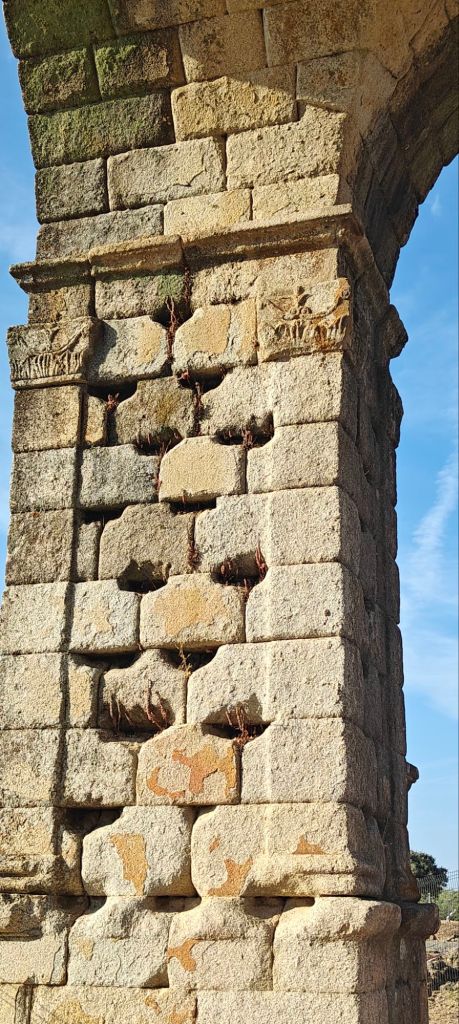
The highlight of today’s stage is the arch of Cáparra, and it’s almost an obligatory selfie to prove you’ve walked the via. Cáparra was a “mansio”, the settlements placed at regular intervals to serve and support anyone travelling on the official business of the Roman Empire. Many mansios evolved into regular towns, but for some unknown reason Cáparra did not, and in the Moorish period it became a ruin, and was never rebuild during the reconquest of Spain by the Catholic monarchs.


 2saunter